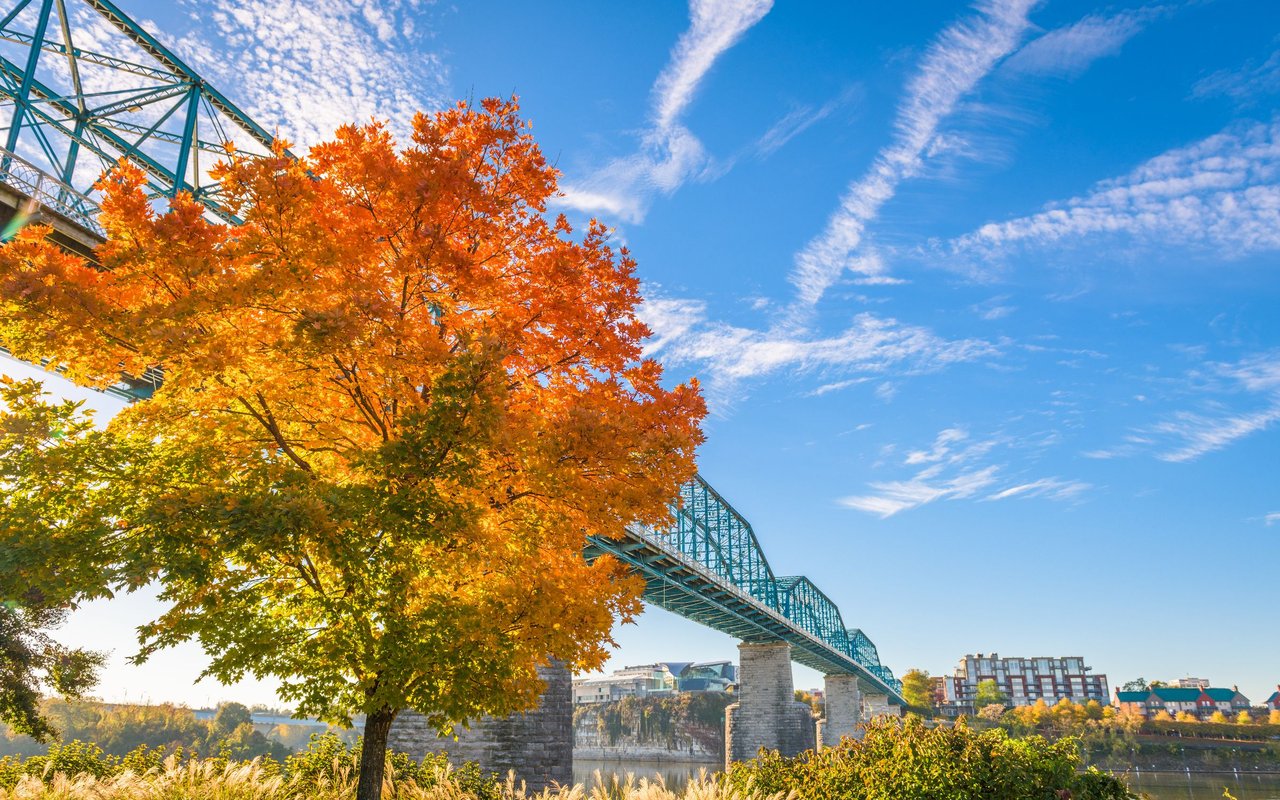
When the Walnut Street Bridge closed in March 2025, The Ice Cream Show had 22 employees. By last winter it had four, and owner Lynda Curtis told the Chattanooga Times Free Press that business was so slow only one of them worked at a time.
On the other side of the river, Frazier Avenue's sales-tax collections over the same 18 months stayed about where they had been before the closure, according to city data cited in the same report.
It was the same bridge and the same closure, and the two ends came out very differently. Now that the bridge has been open for a month, the gap between them is the best guide to what you'll find on each side.
A $52 million rebuild of the structure
The city reopened the bridge on Saturday, October 3, 2026, just days past the late-September target the city had said in March it was on track to meet. The city estimates that more than 20,000 people walked the new planks on reopening day alone.
The cost tells you how deep the work went. In 2024, City Council awarded Southern Road and Bridge a $35.3 million contract, funded with $18.8 million in federal money and more than $16 million from the city's hotel-motel tax. By May 2026, the Times Free Press reported the total had risen to about $52 million. Crews had found deterioration hidden in the timber, the steel and the underwater structure, and federal grant money covered the increase.
The Times Free Press's breakdown of the restoration lists the work piece by piece.
- The deck. Nearly two acres of decking were replaced with yellow Alaskan cedar, which resists rot naturally. The new surface drains better, so less water sits in the wood.
- The steel. More than 200,000 pounds of steel went into repairing or replacing worn pieces, and all of the steel was repainted.
- The cables. About 3.5 miles of coated steel cables were replaced.
- The wiring. More than 62 miles of new wiring, plus new power supplies, transformers and conduits, mean events on the bridge no longer need noisy generators.
- The lights. They can now change color, though the city says they will usually shine white.
According to the same report, the city says these repairs bring the bridge back to the condition it was in when it became a pedestrian bridge in the 1990s, or better. That history is worth keeping in mind. The bridge opened in 1891, carried every kind of traffic from horse-drawn carriages to cars until it closed in the 1970s, and was slated for demolition before Chattanoogans rallied to save it. The city's project page lists some small punch-list items still underway after the reopening.
The south end runs on people crossing the bridge
The Ice Cream Show has been open for 17 years in the plaza across from the bridge's southern entrance. That plaza connects people on foot to the bridge, the Hunter Museum of American Art and the Tennessee Aquarium. Two big attractions sit right next door, so you might expect the shop to do fine without the bridge.
The shop knew better before the closure began. Its manager told Local 3 News that nine in ten customers surveyed had come from walking the bridge. The shop planned to stay open anyway and hoped the Aquarium and the Hunter would keep visitors coming. Staff falling from 22 to four shows how much that one route mattered.
The return was just as sharp. Curtis told the Times Free Press that the first few days after the reopening felt like a holiday, and that she was getting ready to go back to regular hours. "I am thrilled that the bridge is open," she said. "It looks beautiful, and I hope it last for another 20 years."
The lesson from the south end is that the plaza works as a doorway. Customers there are mostly on their way somewhere, and the bridge is where they're headed.
The north end held up, and Frazier Avenue explains why
On Frazier Avenue, the closure felt quieter without breaking anything. Gail Rich manages In-Town Gallery, an artist co-op on Frazier. She told the Times Free Press that business got "sleepier" while the bridge was closed. People could still walk over the Market Street Bridge, she said, but it didn't create the same excitement. She estimated that about 80% of the gallery's business comes from foot traffic, made up both of people from the community spending a day on the North Shore and of tourists.
A street that people visit for its own sake, including people who already live here, keeps getting visitors when its main pedestrian route closes. The city's sales-tax figures for Frazier back that up. Collections in March 2025, the month the bridge closed, were a little higher than in March 2024. Collections in the busy June and July stretch were down only slightly from the year before.
Even so, the reopening made a difference. Rich said business has been booming since, and the gallery has put Walnut Street Bridge pieces in its front windows to draw people in. Geno Wallace, who owns Geno's Salon and is president of the North Shore Merchants Collective, described the reopening walk to the paper: "It's almost like a weight has been lifted."
The closure gave the North Shore time to add new shops
The stability on Frazier gave new businesses room to open. Pedestrian Wine and Cheese sits right next to the bridge's northern entrance, and owner Bill Reed opened it after the bridge had already closed. His goal, he told the Times Free Press, was a shop that didn't depend on the bridge. Opening during the quiet months gave it time to find its place in the community, and now the reopening will show what tourism adds.
"With the bridge opening, it's kind of a new start for all the businesses," Reed said. "Some didn't stay. Some are brand new to the area."
You can see that turnover a block away. Sean Alexander replaced his Build-A-Salad concept at 129 N. Market St. with Zeekz House of Gyros, which opened October 3, the same day as the bridge. He told the Times Free Press that he made more on that first day than he would have in a week at the old business.
Reopening day also ended a long run on Frazier. Julie Darling Donuts at 121 Frazier Ave. closed October 3 after 16 years under the Kuenzli family. New local owners planned to reopen in early November once renovations were finished, the Times Free Press reported. According to Chattanoogan.com, the new owners plan to keep the current recipes and add a refresh and new offerings.
So the north end you walk into now has changed more than the bridge has. Some of the shops greeting you at the end of the cedar deck opened while nobody could cross.
Walking both ends this month
If you haven't crossed since the reopening, this route takes you past each part of the story in order:
- Start in the south plaza. Stop at The Ice Cream Show, the business that felt the closure most. The Hunter Museum and the Tennessee Aquarium are a few steps away.
- Cross on the new cedar. Look down at the new decking, which drains better, and up at the repainted steel. After dark, the lights are back and usually shining white.
- Step off next to Pedestrian Wine and Cheese at the northern entrance, the shop built to get by without the bridge.
- Walk Frazier Avenue past In-Town Gallery, where bridge pieces fill the front windows, and on to 121 Frazier Ave., where Julie Darling Donuts is starting over under new owners.
- Turn onto N. Market St. for Zeekz House of Gyros at 129, which opened the same day as the bridge.
The new wiring also means events on the deck itself can now run without noisy generators.
If you own a home within walking distance of either end, the past 18 months show how much these blocks lean on the bridge, and every block leans differently. Grace Frank Group follows that block-by-block detail when we price homes near downtown and the North Shore. Request a home valuation, and we'll show you how your address fits the North Shore and downtown as they look now that the bridge is back.